

The UAE Is Going Global: Why Understanding 'How Banks Think' Is Essential for Business Survival
As UAE companies expand across global markets, payments specialist Viktoria explains why mastering banking infrastructure, navigating compliance, and treating payments as a strategic priority can make or break international success.
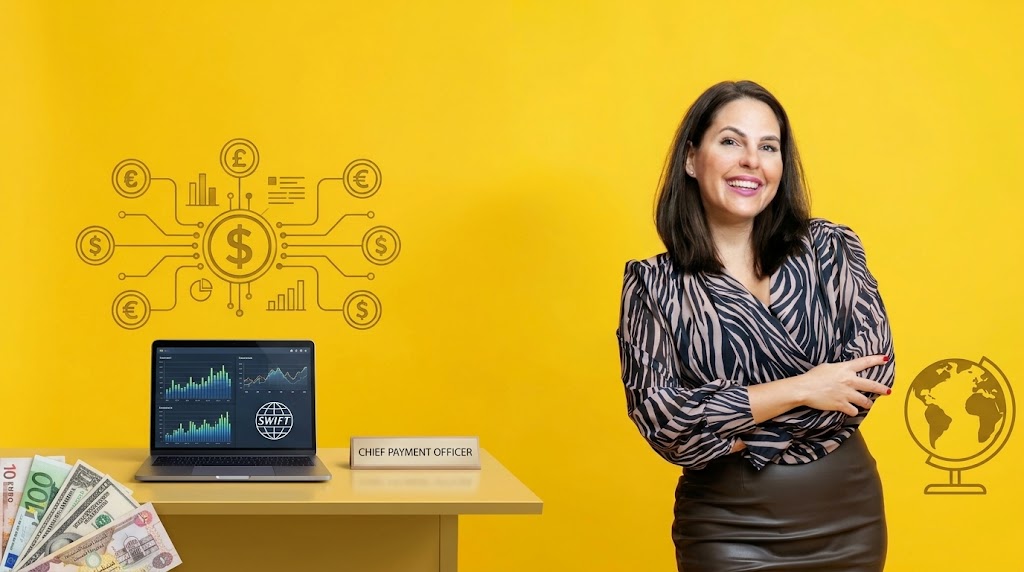
The UAE Is Going Global. But to be successful, businesses must understand "How Banks Think" and "How Money Moves" internationally.
As the UAE strengthens its position as a global destination for business, investment and innovation, payments and banking specialist Viktoria argues that one capability is becoming essential for every ambitious company: understanding what actually happens to money after we press “pay.”
With more than two decades of experience across taxation, banking and payments, Viktoria has built her career around an area that is critical to international business yet often remains invisible: understanding how money moves globally.
Her journey began in Cyprus as a tax accountant working with international companies before moving into banking and payments. Today, she works with the largest international companies, building payments and banking strategies, providing executive education and corporate training, and is behind the Chief Payment Officer initiative, which aims to recognise banking and payments as a stand-alone function.
As businesses increasingly choose the UAE as a base from which to operate internationally, Viktoria speaks to Al Wathba about the hidden challenges of payments, the mistakes founders make, AI-driven financial risks, and why understanding the language of banks is not just a competitive advantage, but a must for survival.
“Payments are no longer a back-office issue” You started in taxation. What made you move into banking and payments?
The transition came through my clients. More and more, international companies were asking questions that went beyond taxation: Which bank should we use? Which payment provider? Why was a transaction rejected? How do international payment systems actually work?
I realized there was a major knowledge gap. Every company seems to have a problem with payments and banking, but it seems like we only resolve the issues after they happen. And it is all due to the lack of basic knowledge about payments and banking. People do not even know the basics, such as the difference between SEPA and SWIFT transfers.
And these are not small operational details. A wrong decision involving banking or payments can become very expensive and, in some cases, can even kill the entire business.
Does every major company need a Chief Payment Officer? You are behind the Chief Payment Officer concept. Why do you believe payments deserve their own professional discipline?
Because payments sit at the intersection of almost everything: finance, technology, compliance, regulation, customer experience, marketing and international expansion.
These areas have their own individual experts, but very few professionals are taught to see the complete journey of money through a company.
The idea behind the Chief Payment Officer is the increasing need to have someone who makes an optimum decision not just for one department but for the whole organisation. The goal is to define the scope, which then sets the standards, summarises the best practices and creates professional frameworks that help international businesses make the right decisions around their money.
The UAE opportunity: build here, think globally What does the UAE’s rise as an international business hub mean from a payments perspective?
The UAE has created a highly attractive environment for entrepreneurs, companies and international professionals. It combines global connectivity with an increasingly sophisticated business and financial system.
That creates enormous opportunity.
But when you build a business in a globally connected economy, you also need to think globally about your financial infrastructure.
A UAE-based company may have customers, suppliers or investors across Europe, Asia and the United States. Every market can have different banking requirements, compliance expectations and preferred payment methods.
The stronger your international ambitions, the more important it becomes to understand those differences.
“Being legal is not the same as being bankable” What is one misconception you would like every founder to understand?
Founders sometimes assume that if a company is legally registered, banking and payments will automatically follow.
It could not be further from the truth.
Banks and payment institutions are individual companies with regulatory responsibilities that determine their own risk criteria. They look at the business model, ownership, jurisdictions, transaction patterns, customers and many other factors to understand "what could go wrong." And even if you are fully legal, if there is an opportunity for problems, they have every right to reject you as a customer.
The most successful entrepreneurs learn to understand why financial institutions ask questions and work with the banks rather than treating every compliance request as an obstacle.
I often say: learn to speak the bank’s language.
When you understand the system, you can build your company in a way that makes it easier for financial institutions to understand and support you.
The expensive “I can do it myself” mistake Has AI made founders too confident about handling specialist areas themselves?
There is certainly a temptation today to believe you can do everything yourself.
You can ask AI about a contract, taxation, accounting or payments and receive an answer within seconds. These tools are extremely useful, but information can often be misleading, and it is not the same as professional judgment. Even small mistakes can be extremely expensive if they are about your money.
A founder might save a few hundred dollars by avoiding specialist advice at the beginning, only to discover later that the bank froze their account in the middle of a campaign, or their payment structure cannot support an increased number of clients when they go viral.
Professional advice should not be viewed only as a cost. It is like a checkup with the doctor to stop the development of a larger problem.
Going global? Don't leave payments until last What do companies most often underestimate when expanding internationally?
They focus on the product and marketing and assume payments will simply work.
But local behaviour matters.
Customers in different markets may prefer different payment methods. A company can spend heavily attracting customers and then lose them at checkout because it failed to provide the payment experience they expect.
Regulation can also differ significantly between markets. Something permitted in one jurisdiction may be restricted in another, and that can influence whether banks and payment processors are comfortable supporting the business.
Payments, banking and compliance should therefore be part of an international expansion strategy from the beginning, not something addressed after entering the market.
AI is making finance smarter, and fraud smarter Where do you see AI having the greatest impact on financial systems?
AI is creating extraordinary opportunities, but the same technology can also make fraud far more sophisticated.
We are already dealing with AI-generated documents, deepfakes and increasingly convincing impersonation attempts. For banks and financial institutions, verifying who and what is real becomes more difficult.
There is also an accountability question. As we give automated systems more authority to make decisions or move money, who is ultimately responsible when something goes wrong?
Innovation cannot be separated from governance. The faster technology develops, the more important security, accountability and human judgment become.
“I don't want to be seen as a woman in business” Finally, has being a woman shaped your journey in a traditionally complicated financial industry?
I am all for merit. I don't particularly want to be seen as a woman in business; I want to be seen as a hardworking professional in business.
One positive change in recent years is that technology has become a great equalizer. You can work internationally, demonstrate your expertise and build relationships without geography defining your opportunities.
For me, it comes down to individual strengths and what a person can contribute.
With an internet connection, a computer, expertise and determination, the world is more accessible than it has ever been.
Understanding the money behind the ambition Viktoria’s message to business leaders is ultimately straightforward: moving money has become easy only on the screen, but the system behind that screen has never been more complicated.
For companies building from the UAE and looking outward to global markets, understanding that payment and banking planning is no longer optional. It is a life-or-death decision for a business that requires specialised expertise.
Because in the next generation of international business, leaders may not need to become bankers, but they will need to understand how bankers think to be able to operate.
More from Smart Media
All news Business & Economy
Gulf capital markets enter a new cycle of disciplined growth
Listings, sovereign capital and private credit are reshaping how regional companies fund expansion, and how boards communicate with investors.
 Business & Economy
Corporate anniversaries become strategic milestones
Fiftieth and hundredth anniversaries are being used to reposition institutions, not merely celebrate them.
 Abu Dhabi
Hana-chan: The Social Robot Redefining Emotional Care – A Special Showcase from the Abu Dhabi Health Summit
Discover how Peter Julius and Public Intelligence are using GROOVE X's LOVOT ("Hana-chan") as an advanced low-arousal therapeutic tool in Danish primary care.